

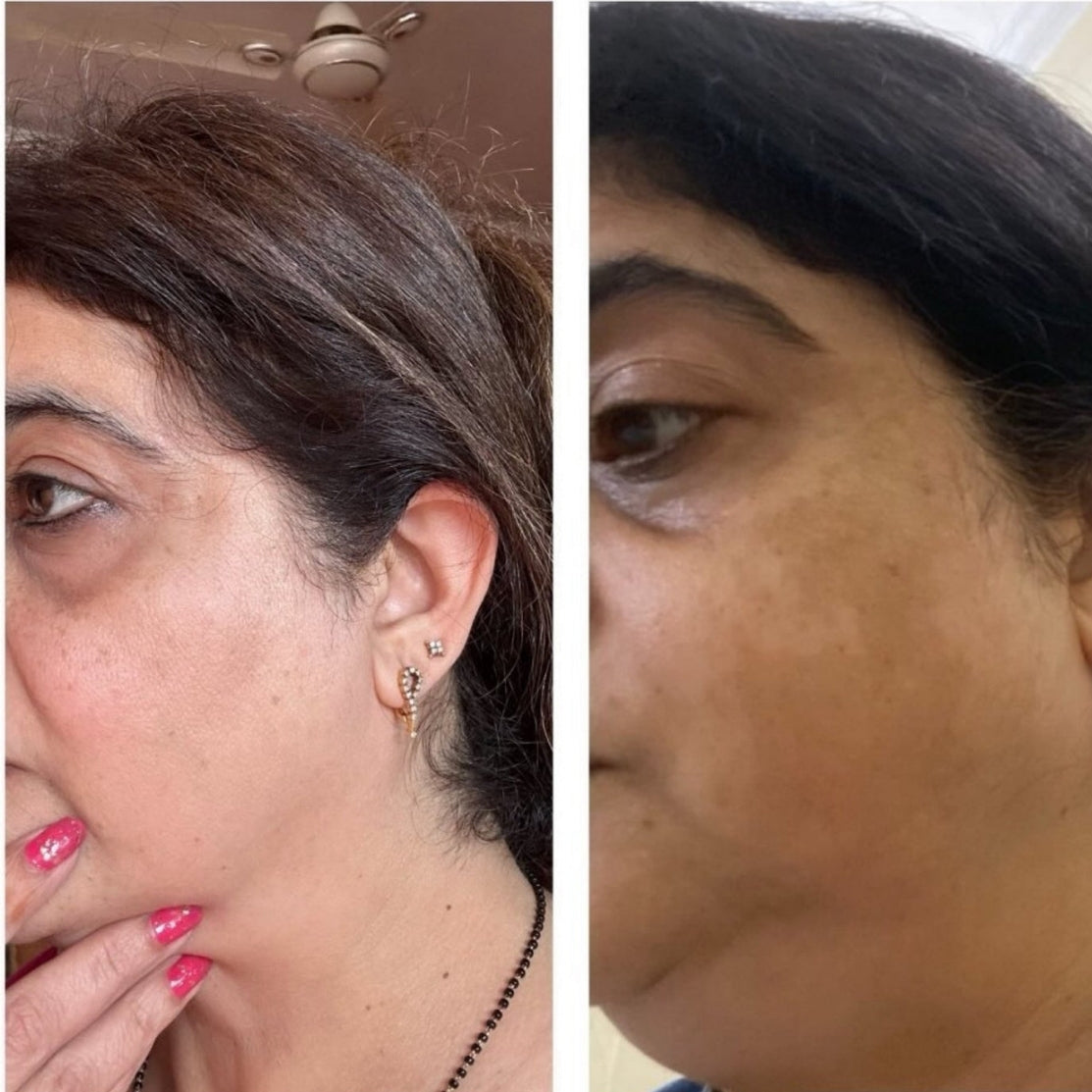


Have you not always found one eyebrow lower than the other? Or a half side of your face is a little flatterer, weaker or more droopy in photographs? There are times when it is the eyelid that becomes heavy. In some cases, there is an unevenness of the jaw. Everyone calls this an asymmetrical face and it is pretty common.
Asymmetry of the face does not just come in one day. It tends to progress gradually due to the daily habits such as chewing on a single side, posture or stress, screen time or age. With age, one of the face muscles gets weak and the other is hyperactive. The result is imbalance.
The positive fact is that facial muscles can be trained as well as body muscles. You can learn to increase balance and strength naturally, with the help of the right face yoga postures and only with some dedication, without invasive procedures.
Let's know how to solve the issue of asymmetry in the face in a non-ludicrous manner.
Why Does Face Asymmetry Happen?
We have over 40 muscles on our face. When the body uses the muscles more than others, then imbalance sets in.
Common causes include:
-
Sleeping unilaterally consistently.
-
Mostly chewing on one side of the food.
-
Hours of screen time, which is straining to the eye.
-
Clenching jaws created by stress.
-
Older faces have weak facial muscles.
Extremely in some instances, the facial spasms or drooping may even be caused by muscle weakness. In the view of the greater majority, however, asymmetry is mild and may naturally be reduced by simple exercises.
Face yoga comes in there.
Can You Really Fix an Asymmetrical Face Naturally?
The question many people ask is how to repair the asymmetrical face with no consideration of surgery?
The reply is yes, greatly.
Face yoga works by:
-
Strengthening weak muscles
-
Resting of overworked muscles.
-
Enhancing the blood flow.
-
Stimulating nerves
-
Promoting the use of natural lifts.
Face asymmetry may also be corrected gradually with practice. It's not about perfection. It's about balance.
Effective Face Yoga Exercises for Facial Balance
The following are some facial yoga exercises that are not aggressive but effective:
-
Dancing Eyebrow Exercise
In case one side of the eyebrows is lower and weaker than the other side, this practice can be used to reinforce that section. Put the index and middle finger on the weaker part of the eyebrows. Ground on the muscle directly over the brow, using hard, but soft circular movement. Repeat this three to six times. This excites the muscles involved in lifting the eyebrows and strengthens the muscles in the long run.
-
Blinking Exercise of Droopy Eyelid.
Most of the people observe that one of the eyes seems smaller or more fatigued than the other. It occurs when the muscles of eyelids become weak. Using the index finger get a hooky shape and hold it close to the weaker eyebrow with light pressure. And do not frown or counter-frown. The placement should be soft. Blink the weaker eye now slowly three or six times. Relax and repeat. This activity exercises the eye muscles, and prevents them from drooping with age.
-
Cheek Lifting Massage
In case one side of your face appears to be flatter or even drooping, the cheek muscles are possibly weak. Put a touch of oil on your fingers. Gently lift the muscle of the cheeks with a finger and thumb in firm strokes. Move upwards in motions along the cheek, approximately 20 counts. This enhances the circulation, tightens the muscles of the face, and promotes the lifting.
-
Jawline Tension Release
Face asymmetry is caused in large part by jaw imbalance. With the index finger and thumb on your chin, circular movements of the jawline should be massaged slowly. Get to the muscle which is near your ear (masseter muscle) and break here and make three to six clockwise and anti-clockwise circles. This will be a little painful - that is all. It eliminates rigidness and recovers muscle tone.
-
Slapping Piano Exercise
This is funny to say the least. With two fingers on one side support your cheek. On the other hand, tap or slap softly an inward stroke of the smile line to the ear six or eight times. This activates nerves, enhances muscle contraction, and assists in the elimination of asymmetrical smile lines.
-
Cool Down Stretch (Snake Pose to Face)
To complete your workout, make a relaxing stretch. With one hand raise one eyebrow, which is weaker. Get the other hand on your shoulder, bend a little and see down the neck. Inhale deeply. Breathe out as you do with your tongue pressed out and vibrate. Repeat two to three times.
How Often Should You Practice Face Yoga and its Results
These face yoga exercises should be practised three to five times a week to get the best results. The session will only last 10-15 minutes. It is more about doing something consistently rather than intensively. In the long run, muscles become stronger on their own and faces become more balanced. You can expect these results overtime-
-
Better muscle control
-
Reduced drooping
-
Improved symmetry
-
More lifted appearance
-
Less tension in jaw and eyes
-
Healthier glow
Others experience lightening of the facial muscles in a matter of a week. The visible changes may be observed in four to eight weeks of regular practice.
Simple Habits That Help Reduce Face Asymmetry
In addition to exercises, minor components of life change are significant:
-
Evenly chewing food on either side.
-
Switch sleeping sides
-
Reduce screen strain
-
Stay hydrated
-
Relax your jaw consciously
Final Thoughts
It is quite normal to have an asymmetrical face. Virtually nobody is balanced to perfection. However, when you feel like it, there are exercises that you can do to your face that can achieve a balance in a natural, non-harmful manner. Face yoga is aimed at tightening weak muscles, eliminating stress, and enhancing blood circulation. This creates a more uplifted, collected, and younger look over time, of course. Balance is associated with patience, care and consistency, and your face is as capable of amazing self-correction as long as you are guided properly. Face yoga exercises are the first step to improve your face asymmetry in a non-invasive manner.